






The Essence of Balance
The Origin
Ginkgo, also called Ginkgo biloba, is one of the oldest living types of trees. Most ginkgo products use extract from ginkgo's fan-shaped leaves.
Ginkgo has two main substances that are good for health. Ginkgo has flavonoids, which are antioxidants that help protect the body's cells from damage. And it has a type of terpenoid. Terpenoids help keep blood moving by widening blood vessels.
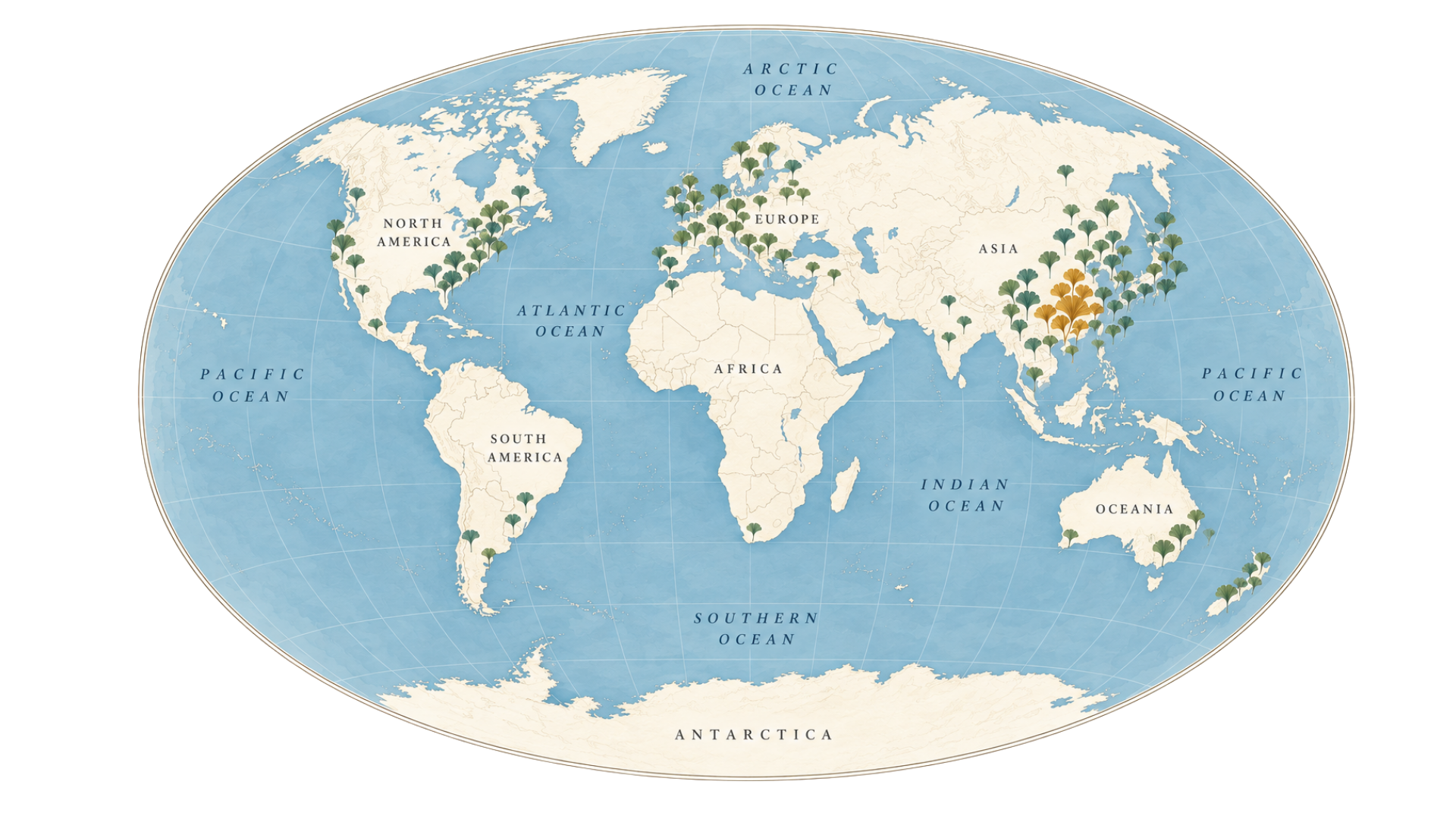
From its origins in China, Ginkgo biloba has travelled across centuries and continents, becoming established throughout much of the temperate world.
The gold leaves on this map mark its ancestral origin, while the green leaves illustrate its present-day cultivation, particularly across East Asia, Europe, and eastern North America.
This remarkable distribution tells the story of a species shaped by both nature and human cultivation—an ancient botanical lineage that continues to thrive far beyond the landscape in which it first emerged.
The Distinction
Few species embody resilience as strikingly as Ginkgo biloba. Several ginkgo trees survived the atomic bombing of Hiroshima in 1945, recovering from severe damage and producing new growth in the years that followed, with some still living today.
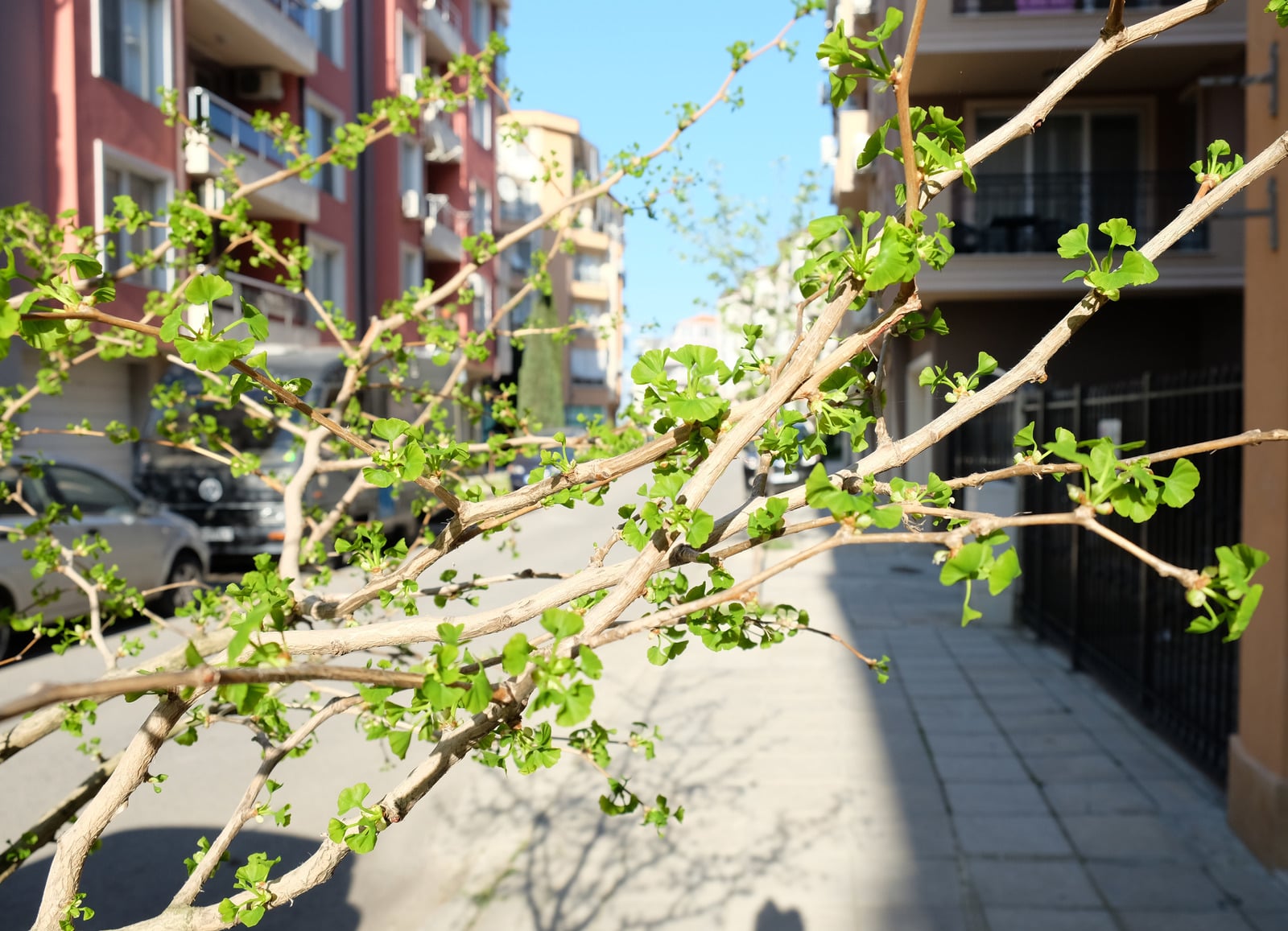
This remarkable endurance reflects the tree’s broader biological resilience: ginkgo possesses sophisticated natural defence mechanisms that contribute to its resistance to many pests, pathogens, and environmental stresses, while its tolerance of pollution and difficult urban conditions has made it a familiar presence in cities around the world.
Its longevity is equally extraordinary. Some specimens are believed to have lived for more than 3,000 years, and research suggests that even very old trees can retain active defence and regenerative processes, continuing to produce new tissue and maintain robust physiological function across centuries.
The Anatomy
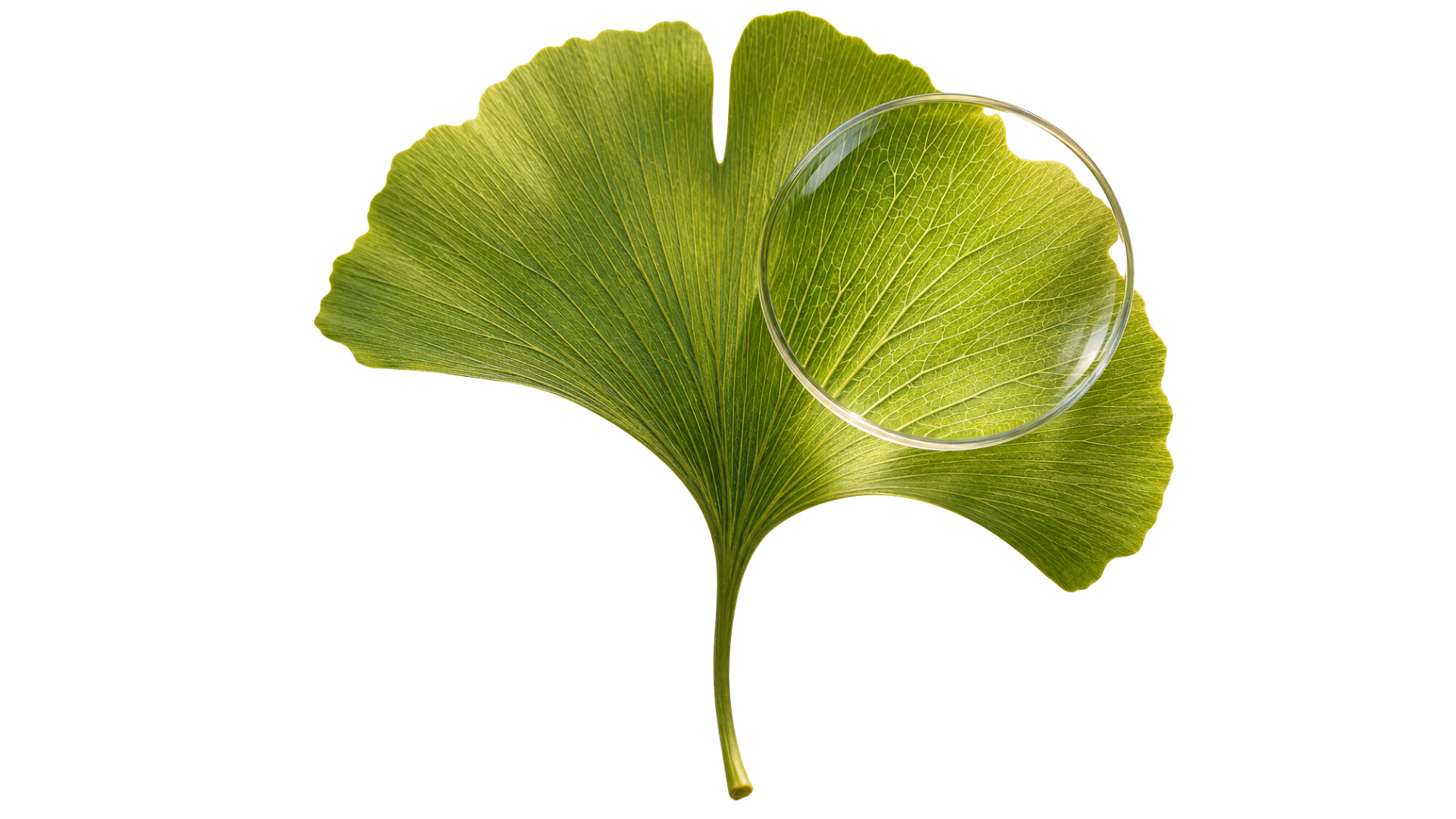
Few leaves are as instantly recognisable as ginkgo’s. Suspended from a slender stalk, each opens into a broad fan, its gently undulating edge sometimes interrupted by a central notch. This division gives Ginkgo biloba its species name: biloba, meaning “two-lobed.” Yet the silhouette is never entirely uniform; some leaves are deeply divided, while others form an almost continuous arc.
Look closely, and the surface reveals a delicate geometry. Fine veins radiate from the base, repeatedly forking into two as they approach the outer edge. Known as dichotomous venation, this pattern differs from the interconnected network of many broadleaf trees. It gives the ginkgo leaf its distinctive linear texture, with each branching vein tracing the widening shape of the fan.
The branches carry their own variations on this form. Long shoots extend the tree’s framework, bearing leaves at intervals, while compact short shoots hold them in close clusters. Leaves on the longer shoots are often more deeply notched; those on short shoots tend to be less divided. Within a single canopy, the same familiar outline appears in subtly different proportions.
Autumn brings its most striking transformation. As green chlorophyll breaks down, yellow carotenoid pigments become more visible, turning the foliage a luminous gold. The architecture remains unchanged, but its details take on a new clarity: fine veins, curved margins and slender stalks, briefly illuminated before the leaves fall.
The Composition
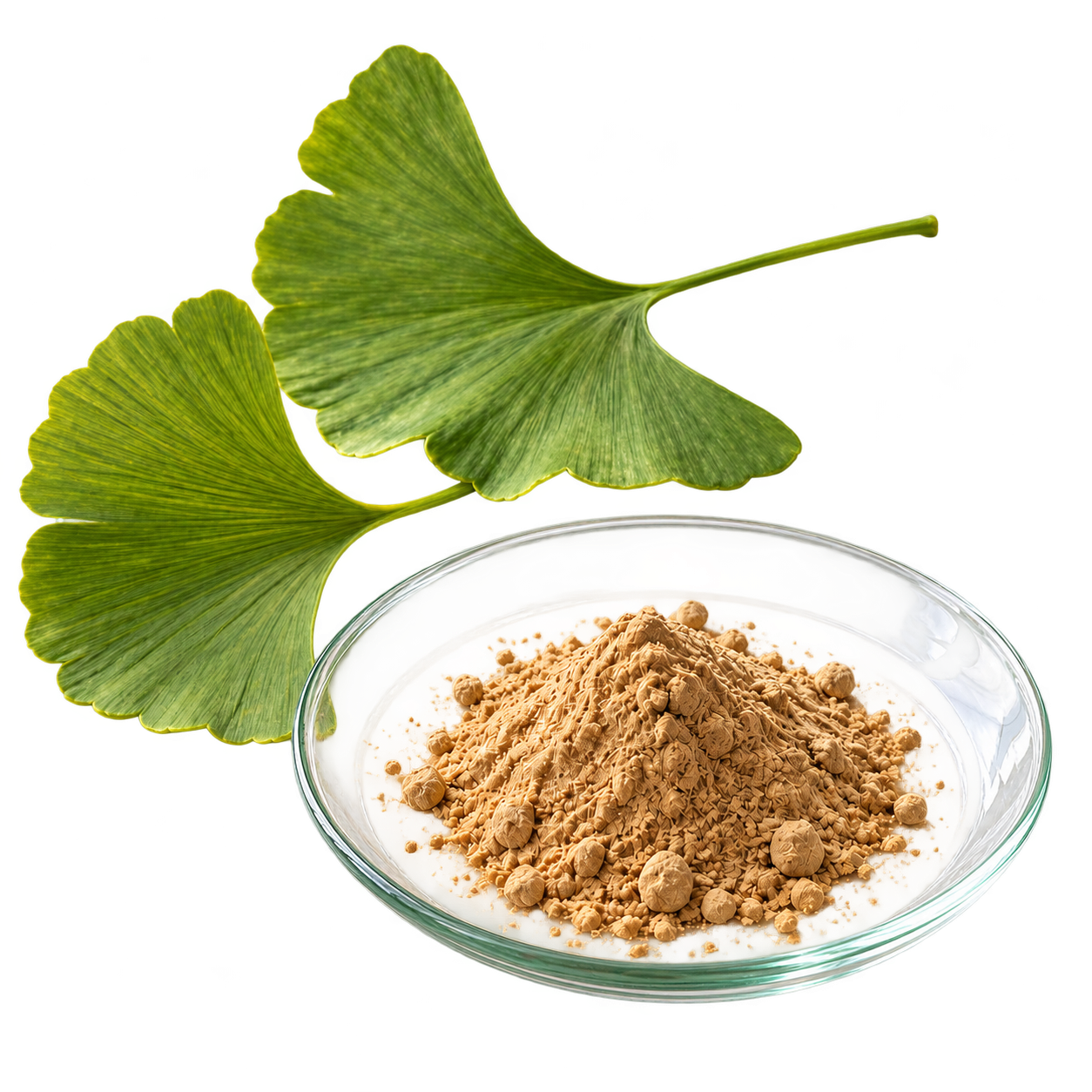
The ginkgo leaf’s distinctive form is matched by a complex inner composition. Among its many natural constituents, two families have drawn particular scientific attention: flavonoid glycosides and terpene lactones. Alongside them are biflavones, proanthocyanidins and organic acids—part of a varied botanical chemistry that extends well beyond the compounds for which ginkgo is best known.
Its flavonoids include derivatives of quercetin, kaempferol and isorhamnetin. Many occur as glycosides, in which the flavonoid molecule is linked to one or more sugar units. These variations may be invisible to the eye, but they are central to the leaf’s chemical identity: a collection of related compounds, each with its own molecular structure.
The terpene lactones provide another distinctive signature. They include ginkgolides A, B and C, together with bilobalide— compounds known for their intricate molecular structures. These constituents have become important reference points in the study of ginkgo, helping researchers characterise its extracts and examine their composition with precision.
Within the living leaf, these proportions change. Studies have recorded differences in flavonoid and terpene lactone concentrations across the growing season and between cultivation sites. The timing of harvest and the conditions in which a tree grows therefore matter. Behind the apparent simplicity of the fan lies a chemistry that develops with the leaf itself.

The Legacy
Within the temple grounds of East Asia, ginkgo became part of a cultural landscape shaped by reverence and continuity. Its presence extended beyond the garden into art, where the distinctive fan appeared in paintings, jewellery and decorative objects. A leaf recognised by botanists for its unusual structure became equally valued for the elegance of its form.
In 1815, Johann Wolfgang von Goethe found a more intimate meaning in that silhouette. His poem Ginkgo biloba considers the leaf’s divided form as an image of two existing as one—a reflection on connection and unity.
It offers an enduring expression of ginkgo’s cultural appeal: a tree that invites close observation, and a leaf that leaves room for interpretation.
Follow us and don’t miss any upcoming articles
Our way of thanking you for choosing E.N. Biomedical.
Earn points
Receive 10 welcome points when you join, then earn 1 point for every $1 spent on products. Your points accumulate with each purchase, bringing you closer to your next reward.
Choose your reward
• 100 points — $5 off your next purchase.
• 400 points — A complimentary product of your choice, valued at up to $75, added to your next paid order.
Enjoy a little saving along the way, or keep collecting points for a complimentary addition to your routine.
A few details
Points are calculated on the amount paid for products after discounts, excluding taxes and shipping. When you redeem a reward, the corresponding points are deducted from your balance.
Complimentary products are subject to availability and must accompany a paid order. Shipping charges, where applicable, remain payable.
All amounts are in Canadian dollars.